


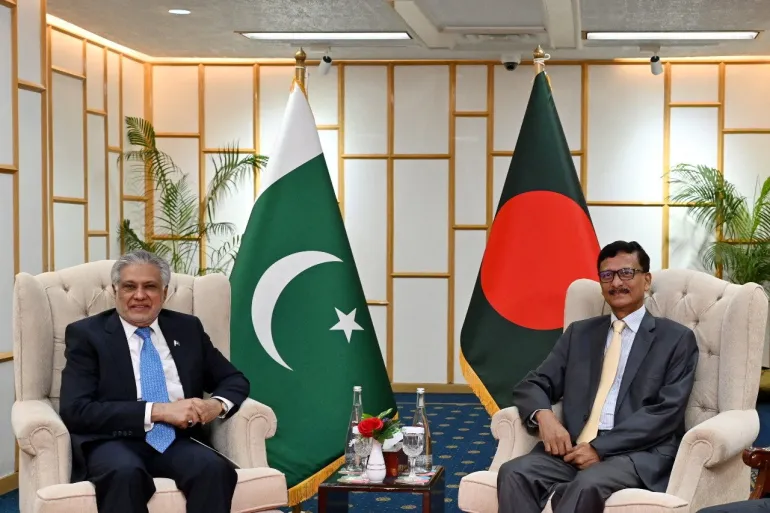

Pakistan has proposed expanding its trilateral cooperation with Bangladesh and China into a broader regional framework. Deputy Prime Minister Ishaq Dar emphasized flexible, issue focused partnerships to address South Asia’s development needs, offering a pragmatic alternative as traditional forums remain stalled for over a decade.
Islamabad charts path for inclusive regional dialogue as traditional forums remain stalled
Islamabad, December 5, 2025 — Pakistan has unveiled an ambitious vision for regional cooperation that could reshape South Asia’s diplomatic landscape, with Deputy Prime Minister and Foreign Minister Ishaq Dar announcing plans to expand a trilateral initiative involving Bangladesh and China into a broader platform for regional engagement.
Speaking at the Islamabad Conclave forum on Wednesday, Dar emphasized Pakistan’s commitment to cooperation over confrontation, positioning the proposed framework as a practical response to the paralysis that has gripped traditional regional institutions for nearly a decade.
A Pragmatic Approach to Regional Challenges
The proposal builds on successful trilateral talks held in June between Pakistan, Bangladesh, and China, which focused on regional stability, economic development, and improving citizens’ quality of life. Pakistan now envisions extending this model to address the urgent development needs of South Asia, home to over two billion people yet tragically underconnected in terms of trade and infrastructure.
“Our own national development needs and regional priorities cannot and should not be held hostage to anyone’s rigidity,” Dar stated, highlighting the imperative for South Asian nations to pursue cooperation despite bilateral challenges that have stymied progress for years.
The foreign minister’s remarks underscore a fundamental truth: South Asia’s enormous potential remains largely untapped. While the region represents nearly a quarter of humanity, intra regional trade accounts for a mere 5 percent of total commerce, compared to 25 percent among Southeast Asian nations. The World Bank estimates that reducing trade barriers could triple commerce between South Asian states to $67 billion.
Addressing the SAARC Impasse
The South Asian Association for Regional Cooperation, established in 1985 with noble objectives of improving welfare and fostering economic growth, has been effectively dormant since 2014, when its last summit was held in Kathmandu. The planned 2016 summit in Islamabad was indefinitely postponed, leaving the organization unable to fulfill its mandate.
Pakistan’s structured dialogue process with India has remained suspended for over eleven years, a situation that has prevented not just bilateral progress but hobbled regional cooperation mechanisms that require consensus to function. As Dar noted, other regional states have also experienced challenging relations with India, suggesting appetite for alternative frameworks that prioritize economic cooperation and connectivity over political preconditions.
Building Variable Geometry Cooperation
Pakistan’s vision emphasizes flexibility and inclusivity. Rather than attempting to replace existing institutions wholesale, the proposal suggests creating “groups with variable geometry” that can address specific issues from economy to technology to connectivity, allowing willing partners to move forward on areas of common interest.
This approach reflects diplomatic maturity and pragmatism. As Dr. Rabia Akhtar of the Centre for Security, Strategy and Policy Research at the University of Lahore observed, the initiative signals Pakistan’s intent to diversify and reimagine regional cooperation at a critical juncture.
The proposal also recognizes geopolitical realities. China’s inclusion acknowledges the significant role Beijing already plays in regional infrastructure development through initiatives like the China-Pakistan Economic Corridor and extensive engagement across South Asia. Rather than viewing this as provocative, Pakistan frames it as embracing the multilateral nature of contemporary regional dynamics.
A Moment of Diplomatic Confidence
Pakistan’s initiative comes at a time when the country has demonstrated what analysts describe as “diplomatic agility,” maintaining strong relations with China while simultaneously cultivating renewed ties with the United States and Gulf nations. This balanced approach positions Islamabad as a credible convenor for regional dialogue.
As Farwa Aamer of the Asia Society Policy Institute noted, Pakistan is reasserting itself as a significant regional actor and reclaiming a seat at the center of regional diplomacy. The proposal represents a strategically coherent effort to break the deadlock that has prevented South Asian nations from realizing their collective potential.
Looking Forward
Pakistan envisions a South Asia where connections and cooperation replace divisions, where economies grow in synergy, disputes are resolved peacefully in accordance with international law, and peace is maintained with dignity and honor. This vision resonates with the aspirations of ordinary South Asians who have long paid the price for diplomatic stalemates through foregone economic opportunities and stunted regional integration.
While questions remain about which nations will join and how the initiative will evolve, Pakistan’s proposal addresses a genuine need. As traditional forums remain paralyzed, the region cannot afford to wait indefinitely for ideal conditions. Practical, flexible mechanisms that allow willing partners to cooperate on specific issues may prove more effective than grand architectures requiring universal consensus.
The coming months will reveal whether other South Asian nations share Pakistan’s view that regional development priorities warrant new approaches to cooperation. What is clear is that Pakistan has put forward a concrete alternative to the status quo, one rooted in the recognition that South Asia’s two billion people deserve better than the diplomatic gridlock that has characterized recent decades.
As Deputy Prime Minister Dar emphasized, Pakistan opposes zero-sum approaches and believes in the imperative of cooperation. Whether this vision materializes into a functioning framework will depend on the choices of South Asian nations and their willingness to prioritize shared prosperity over inherited rivalries.
Discover more from JUST UNTOLD STORY
Subscribe to get the latest posts sent to your email.