



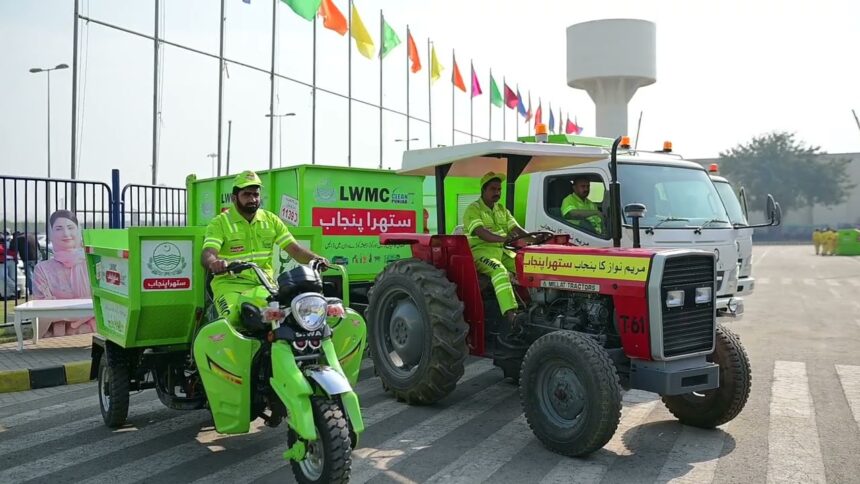

Pakistan’s Punjab province has unveiled Suthra Punjab, the world’s largest unified waste management system, revolutionizing urban sanitation through technology and sustainability. Managing over 50,000 tons of waste daily with 30,000 vehicles, 150,000 workers, and 6,600 geo-tagged enclosures monitored by AI and RFID systems, the initiative transforms waste into economic value through a 25 MW waste-to-energy plant, composting hubs, and carbon-market-ready landfills. With mostly locally-designed technology earning ISO certification and SGS verification, the program reduces up to 90,000 tons of CO₂-equivalent emissions annually while creating dignified formal employment. Chief Minister Maryam Nawaz Sharif’s vision demonstrates how developing regions can lead in climate-smart governance, proving that innovation isn’t exclusive to the developed world.
- A Technology-Driven Ecosystem at Unprecedented Scale
- Accountability Through Data-Driven Performance
- Dignified Employment and Social Impact
- Turning Waste Into Economic and Environmental Assets
- Indigenous Innovation and Technical Self-Reliance
- Political Leadership and Vision
- Global Recognition and the Global South Leadership Narrative
- A Replicable Model for Urban Governance
- Challenges and Future Directions
- Setting a New Standard
LAHORE, PAKISTAN — In a groundbreaking achievement for developing nations, Punjab province has launched what is being hailed as the world’s largest unified waste management system, transforming urban sanitation while advancing climate resilience and economic sustainability.
The Suthra Punjab (Clean Punjab) initiative represents a paradigm shift in how populous regions can tackle waste management challenges through technology, transparency, and environmental innovation. Managing over 50,000 tons of waste daily across Pakistan’s most populous province, the system is setting new benchmarks for climate-smart governance in the Global South.
A Technology-Driven Ecosystem at Unprecedented Scale
The comprehensive system integrates cutting-edge technology with massive operational capacity, deploying 30,000 vehicles and 150,000 sanitation workers across the province. What distinguishes Suthra Punjab from conventional waste management programs is its sophisticated digital infrastructure that ensures complete transparency and real-time monitoring.
The system utilizes 6,600 geo-tagged waste enclosures tracked through RFID-enabled weighbridges, IP cameras, and AI-powered Vehicle Tracking and Monitoring Systems. This technological framework allows authorities to monitor collection efficiency, route optimization, and service delivery with unprecedented precision.
Accountability Through Data-Driven Performance
A cornerstone of the initiative is its shift to entirely KPI-driven contractor payments and performance evaluations. This data-centric approach eliminates discretionary assessments and ensures that service providers are compensated based on measurable outcomes rather than political considerations or subjective judgments.
Citizens are directly integrated into the accountability loop through a robust Complaints Management System, enabling residents to report service gaps and track resolution progress. This participatory approach has strengthened public trust and created a feedback mechanism that continuously improves service delivery.
Dignified Employment and Social Impact
Beyond waste collection, Suthra Punjab has created 150,000 formal sanitation jobs, fundamentally transforming what was previously informal, precarious work into dignified employment with proper wages, uniforms, and safety standards. This formalization represents a significant social advancement, recognizing sanitation workers as essential public servants rather than marginalized laborers.
The initiative demonstrates how environmental programs can simultaneously address economic inequality and labor rights, creating pathways to formal employment for communities that have historically been excluded from standard labor protections.
Turning Waste Into Economic and Environmental Assets
Punjab’s approach extends far beyond collection and disposal, embracing a circular economy model that converts waste streams into valuable resources. Several flagship projects exemplify this transformation:
Waste-to-Energy Generation: A 25-megawatt waste-to-energy plant converts municipal solid waste into electricity, reducing landfill burden while contributing to the provincial energy grid.
Composting Infrastructure: Multiple composting hubs process organic waste into agricultural fertilizer, creating revenue streams while reducing methane emissions from decomposing organic matter.
Renewable Energy Integration: A 5-megawatt solar park has been established at a rehabilitated dumpsite, demonstrating how degraded land can be repurposed for clean energy generation.
Carbon-Market-Ready Landfills: In partnership with the United Nations Environment Programme (UNEP) and the Global Green Growth Institute (GGGI), Punjab is developing engineered landfills designed to qualify for carbon credit markets, potentially generating additional revenue while meeting international environmental standards.
Collectively, these initiatives reduce between 60,000 and 90,000 tons of CO₂-equivalent emissions annually, making a measurable contribution to Pakistan’s climate commitments under international agreements.
Indigenous Innovation and Technical Self-Reliance
Perhaps most remarkably, the majority of Punjab’s waste management technology and machinery have been designed and manufactured locally. This emphasis on indigenous innovation has fostered homegrown technical expertise and reduced dependence on imported solutions that are often ill-suited to local conditions or financially unsustainable.
The locally developed systems comply with International Organization for Standardization (ISO) standards and have received independent verification by SGS, an international inspection and certification company. This validation has earned Punjab global recognition as a model of self-sustaining, data-driven circular transformation.
Political Leadership and Vision
The initiative reflects the priorities of Punjab Chief Minister Maryam Nawaz Sharif, who has positioned clean cities, dignified sanitation work, and climate resilience at the center of her administration’s public service reforms. Her leadership demonstrates how high-level political commitment can translate sustainability goals into concrete, measurable outcomes.
The Chief Minister’s approach emphasizes that environmental initiatives need not wait for perfect conditions or external assistance, but can be achieved through strategic investment, technological adoption, and administrative will.
Global Recognition and the Global South Leadership Narrative
At COP30 in Brazil, Punjab’s Minister for Local Government articulated the broader significance of the initiative: “When governance goes digital, waste becomes wealth — and communities become climate-resilient.”
This statement encapsulates Suthra Punjab’s challenge to prevailing assumptions about innovation and development. The initiative demonstrates that the Global South need not merely adopt technologies and governance models developed elsewhere, but can lead in creating large-scale, technology-enabled public services that are efficient, inclusive, and climate-resilient.
For decades, waste management innovations have primarily emerged from wealthy nations with the resources to invest in experimental approaches. Suthra Punjab’s success at unprecedented scale suggests that developing regions facing the most acute environmental and population pressures may be ideally positioned to pioneer solutions that are both more ambitious and more relevant to the challenges facing the majority of humanity.
A Replicable Model for Urban Governance
The implications extend far beyond Punjab’s borders. Cities and regions throughout South Asia, Africa, Latin America, and other developing areas face similar waste management challenges compounded by rapid urbanization, limited budgets, and climate vulnerability.
Suthra Punjab offers a replicable framework that demonstrates how strategic investment in technology and governance can transform urban waste challenges into lasting climate and economic opportunities. The initiative proves that world-class public services are achievable without waiting for income levels to match those of developed nations.
Challenges and Future Directions
While Suthra Punjab represents a remarkable achievement, sustaining and expanding the system will require continued investment, technological upgrades, and institutional capacity building. Ensuring that contractor performance remains aligned with public interest, maintaining equipment across such a large fleet, and expanding waste-to-value projects to handle growing waste streams will test the system’s resilience.
Additionally, as Punjab moves toward more sophisticated circular economy applications, it will need to develop markets for recycled materials, compost, and other waste-derived products. Creating demand-side conditions that make these economic loops viable will be essential to long-term sustainability.
Setting a New Standard
Suthra Punjab has fundamentally redefined what is possible in urban waste management for populous, developing regions. By combining massive operational scale with sophisticated technology, transparent governance, social equity, and environmental innovation, the initiative has created a new benchmark for climate-smart urban governance.
As cities worldwide grapple with mounting waste challenges and climate commitments, Punjab’s model offers compelling evidence that the solutions may not come from traditional centers of innovation, but from regions with the urgency, scale, and political will to reimagine public services from the ground up.
In demonstrating that governance digitalization can turn waste into wealth and communities into climate-resilient ecosystems, Suthra Punjab has established itself as a case study for 21st-century urban management — one that other jurisdictions would be wise to study, adapt, and emulate.
Discover more from JUST UNTOLD STORY
Subscribe to get the latest posts sent to your email.